Part of admin's adventure in Uncategorized
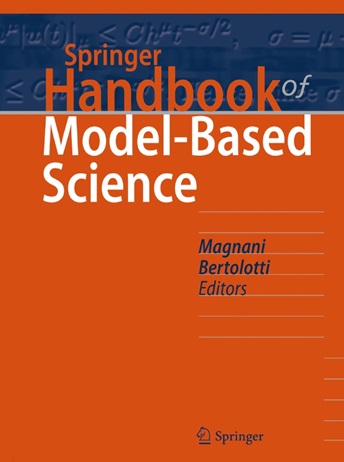
L. Magnani and T. Bertolotti (Eds.), Springer Handbook of Model-Based Science, Springer, 2017.
The Springer Handbook of Model-Based Science offers the first comprehensive reference guide to the interdisciplinary field of model-based reasoning. It highlights the role of models as mediators between theory and experimentation, and as educational devices, as well as their relevance in testing hypotheses and explanatory functions. The Springer Handbook merges philosophical, cognitive and epistemological perspectives on models with the more practical needs related to the application of this tool across various disciplines and practices. The result is a unique, reliable source of information that guides readers toward an understanding of different aspects of model-based science, such as the theoretical and cognitive nature of models, as well as their practical and logical aspects. The inferential role of models in hypothetical reasoning, abduction and creativity once they are constructed, adopted, and manipulated for different scientific and technological purposes is also discussed. Written by a group of internationally renowned experts in philosophy, the history of science, general epistemology, mathematics, cognitive and computer science, physics and life sciences, as well as engineering, architecture, and economics, this Handbook uses numerous diagrams, schemes and other visual representations to promote a better understanding of the concepts. This also makes it highly accessible to an audience of scholars and students with different scientific backgrounds. All in all, the Springer Handbook of Model-Based Science represents the definitive application-oriented reference guide to the interdisciplinary field of model-based reasoning.
To ensure quick and easy access to key information, the book is divided into nine edited parts:
A. Theoretical and Cognitive Issues in Models (ed. by D. Portides) B. Theoretical and Cognitive Issues in Abduction and Scientific Inference (ed. by W. Park) C. The Logic of Hypothetical Reasoning, Abduction, and Models (ed. by A. Aliseda) D. Model-Based Reasoning in Science and History of Science (ed. by N. A. Schwartz) E. Models in Mathematics (ed. by A. Heeffer) F. Model-Based Reasoning in Cognitive Science (ed. by A. Raftopoulos) G. Modelling and Computational Issues (ed. by F. Amigoni and V. Schiaffonati) H. Current and Historical Perspectives on the Use of Models in Physics, Chemistry and Life Sciences (ed. by M. Dorato and M. Marganti) I. Models in Engineering, Architecture, and Economical and Human Sciences (ed. by C. Shelley)




 Editor-in-Chief


Comments Off